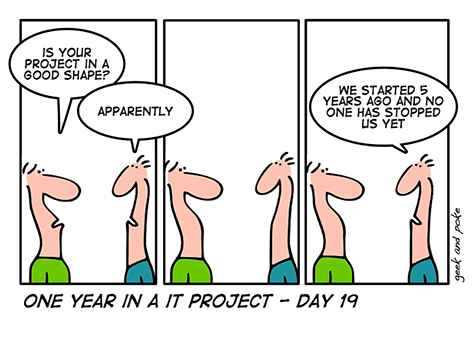
Business as usual leads to results as usual

As regular readers know, I love having guest writers on my blog who describe their network mapping experiences and who enrich the discussion about potentials and challenges. The question that Hippolyte asks below reminds me of a network mapping session with American/European researchers and African policy makers. We asked (after mapping out the policy network): “So where should we feed our research findings in what format to have the biggest possible impact and make sure information goes to those who need it?” The answer was:

“Write policy briefs and give them to the responsible officer in the ministry.”

That sounds reasonable and made the researchers happy. But how is it that we (i.e. the research for development community) have written research briefs and given them to so many “responsible officers” with very little impact on policy making and little flow of information to those on the ground?

Sure, I’m convinced that it can increase our impact, if we ask our partners, how they can use our information best and what they need, to make disemination and action as easy as possible. But if they don’t know what the different communication strategies and experiences are, which we can offer, they’ll tend to say:

“Well, just continue doing what you’ve done all along.”

And if we don’t understand their incentives for making use of the information or diseminating it, which are different in different economic, cultural and political systems, we won’t get far in terms of impact. Do you know any examples that can help Hippolyte answer his question?

Hippolyte Affognon (ILRI) writes: Implementing knowledge acquired through Social Network Analysis training

Eva Schiffer, an expert in Social Network Analysis (SNA), gave training on SNA on the campus of ILRI Nairobi, Kenya from 13 to 17th October 2008.

After the training we applied the knowledge acquired in many workshops in West Africa to identify relevant and effective pathways for disseminating research results on a BMZ funded project on trypanocidal drugs resistance in West Africa.

We found that SNA is a good diagnostic method for analyzing data on patterns of relationships among people or organizations.

We used workshops as means to gather the information necessary for the analysis and we noticed that the absence of relevant actors at the workshops may lead to serious gaps in the analysis.
One problem that we faced was: In a practical and sustainable way, how can those actors that currently show potential for disseminating knowledge and information, actually be provided incentives/capacity to perform this function?

Whose truth?

What do you do if you work with groups of people who tell you a completely different story about the same event? Do you choose one of them and decide that this one is telling you the truth while the rest are lying? How do you choose this one honest one? Because of his/her honest eyes? Because they were the ones you talked to first? Because they are socio-economically or culturally close to you? Becaues their story resonates with your view of the world?

Or can you live with the fact that there really are two (or more) different sides to the story? Can you truely embrace this notion and use the resulting tension to generate next steps that are acceptable for both sides?

Israeli and Palestinian teachers have found an inspiring way of dealing with the fact that the history of the Middle East conflict cannot easily be reduced into one common narrative. In their book “Learning Each Others Historical Narrative” each page has three columns: One for the Israeli point of view, one for the Palestinian one and one that is empty so that students can add their own notes.

I find this approach interesting, not only because students will be able to develop a more complete picture of this specific conflict – I think it’s even more important that it helps to develop the more general notion that your truth might not be the only one that’s true.

A You-Shaped Space in the Universe

The “Perfect Mess” has started a train of thoughts for me about how and why successful and happy people become successful and happy.

Maybe it’s because I’m German, but where I come from, school is mainly about trying to standardize minds, every kid is supposed to produce comparably good results in every subject. Because you have to work much harder for passing those subjects you are not talented in, this means that you spend so much more time working in areas that you are not so good at than in those where you could excel. And while wasting all this time on becoming mediocre in your weak areas instead of becoming stunningly excellent in the fields where your true talent lies, you also learn as a kid that this is how life is supposed to be: Work hard at stuff you don’t like to become sort of medium good at it.

Now looking at people I would rate as both successful and happy, I get the feeling that what they have in common is to be stubborn enough to focus on what they are really good at and shape their work environment in a way that they can excel at these without being disturbed by the fact that they are weak in other areas. I know hyper-focused neat-freaks who are great computer programmers and love the fact that their office is like a high security cave where few people have access. And, on the other side of the spectrum these people-people who cannot focus on one thing for any amount of time but are great at keeping ten different dynamic situations sort-of balanced, making great facilitators. Both would be positively miserable in the other people’s job. Ah, yes and I know a lot of people, who never understood that it is ok to do what you like and what you are good at and who are somehow surviving being mediocre at something they don’t like.

So, is it all about finding (or carving out) a “you-shaped space in the universe”?

If a cluttered desk is a sign of a cluttered mind,

of what then, is an empty desk? (Albert Einstein)

Triggered by Nancy White’s comment I’m curious about the benefits of mess and stumbled over “A Perfect Mess” (by Eric Abrahamson and David H Freedman), a book about “The hidden benefits of disorder – how crammed closets, cluttered offices, and on-the-fly planning make the world a better place”.

While I started reading it, thinking this would be just a humorous self-defense of two messy authors, I found it really thought provoking and enjoyed the (slightly messy) read. They start by analyzing whether the effort of strictly organizing things (all the time and money spent filing and straightening things out) really pays off (their conclusion: It often doesn’t). So that’s the first step of admitting: Often it just doesn’t matter for the results, if something is a bit messy. Then they continue by exploring how people and organizations can actually benefit from mess:

“Specifically, messiness can confer six key benefits: flexibility, completeness, resonance, invention, efficiency, and robustness” (p78)

How to find out everything about small reservoirs

If you want to understand the use and usefulness of small reservoirs in developing countries, you need to know about water, landscape, people, agriculture, fisheries, politics etc. etc.

Working with my colleagues of the Small Reservoirs Project (funded by the Challenge Program for Water and Food of the CGIAR), I was often amazed about the audacity with which they really wanted to find out everything, EVERYTHING that there was to find out about these reservoirs.

And even more, they also wanted to help everyone else to use the tools they developed to understand everything from storage capacity to water politics. I have rarely seen a research project that was able to attract so many dedicated and enthusiastic researchers beyond the original core team and now they have put everything that they have found out about how to find out EVERYTHING (about small reservoirs) together in the Small Reservoirs Toolkit.

“Imperfect” is the new “perfect”?

“Why use messy pen-paper-and-checkers-pieces – can’t you do it on the computer?”

At a Brown Bag Seminar at the World Bank, Regina Birner (IFPRI) and I presented how we used Net-Map to understand innovation systems in Ethiopia. As for the quasi inevitable question afterwards… see above.  “Inevitable” not because it was the World Bank but because it is such a common question that people ask when I do a  presentation about Net-Map. Funny though, the question rarely comes up with groups or individuals who participate in Net-Map activities. Nancy White (check out her cool blog), who attended the World Bank event, made a good point about why messy can sometimes be more than perfect: Drawing something on paper and playing around with checkers pieces invites everyone to participate, to draw and change and debate. If you come with a fancy computer tool that’s a completely different story, that looks like you are the expert and the glossy pictures you draw don’t look as if they are up for discussion.

That makes me think: Isn’t it funny how – as a society – it seems like we have agreed that everything is better and more professional if it is done on the computer?

Web-find: How to say these names…

Hildegard, Aghajan, Bozorgmehr, Olekorinko

Did you get them all right? It’s a sign of respect to pronounce someone’s name correctly, but, sadly, when working internationally, it’s a pretty difficult task… Or do speak German, Armenian, Farsi and Maasai?

Howtosaythatname is a website that does just that, tell you how to say names in the different languages of the world. Very straightforward to use. Elisabeth Bojang, who is running the site, is currently specifically looking for Arabic, Thai, Hmong and Italian speakers to add names in their languages… Email her at info@howtosaythatname.com, if you want to contribute.

Researcher, Facilitator, Advocate?

I just talked with a colleague who wants to do some Net-Map research about water governance in a big irrigation project in Africa, where commercial interests and small farmer needs clash. She has a number of different goals with her research, ranging from “getting a PhD” through “doing high quality exciting research” to “facilitating a debate about power” and “empowering the poorer stakeholders”.

And while it is possible to do all these things with a tool like Net-Map, it made me think about the messy situations we often get ourselves into, trying to be a good researcher and a good person at the same time. How do you deal with the tensions between “wanting to find out” and “wanting to change things / wanting to help”?

Do you know how to use EgoNet?

Or do you know where to find a manual? EgoNet is an open source software for collecting network data online and I’d love to use it. But unfortunately it’s not really intuitive and I just can’t figure it out. If you know how to use it, I’d be grateful for some hints!